The book
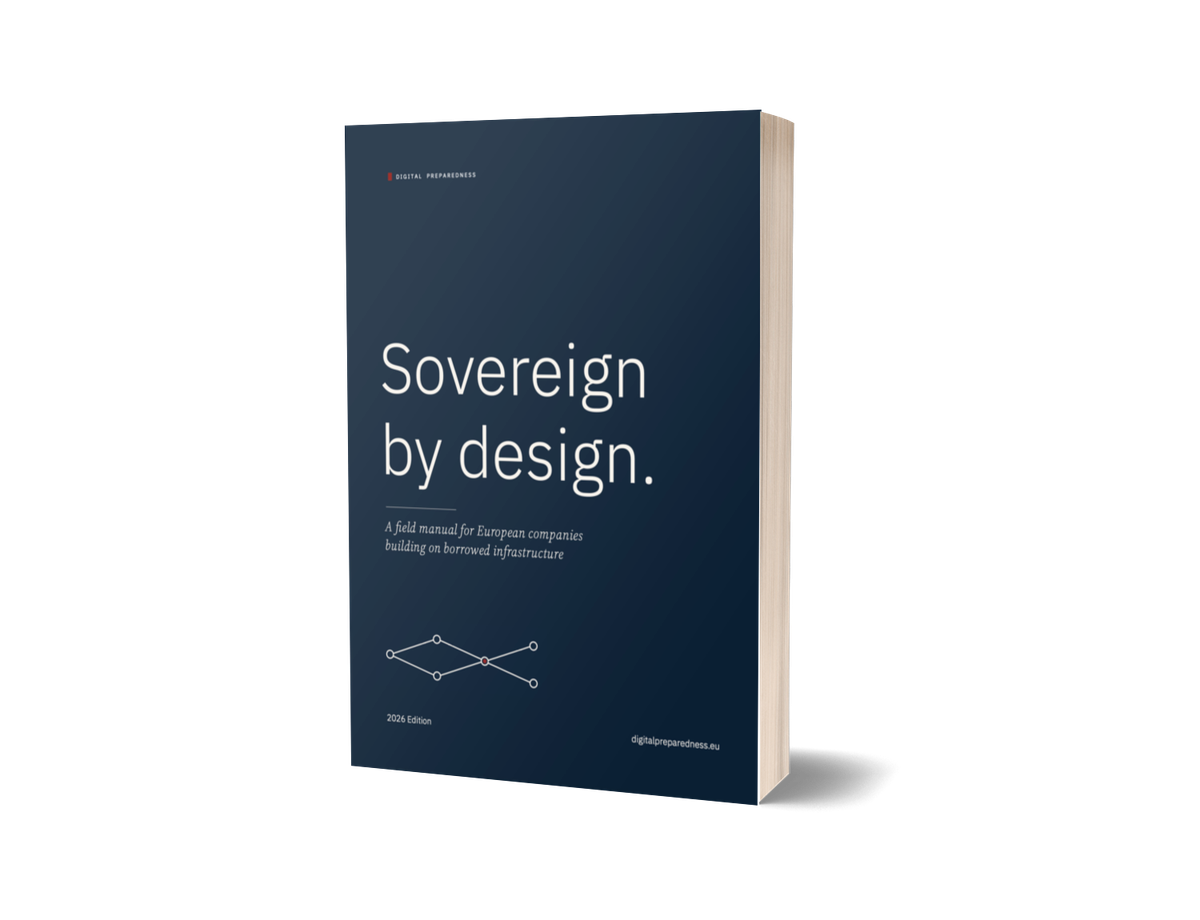
Digital Preparedness for a Fragmented World
The whitepaper I hope you'll never need.
For a decade, European companies built on the assumption that the major cloud providers were permanent utilities: always available, globally reachable, politically neutral. Recent months have challenged each of those assumptions.
This guide is the operator's manual for what to keep, prepare, and test so that your company keeps functioning when those assumptions stop holding.
Why now
In November 2025, a single Cloudflare failure briefly broke a fifth of the web. Days earlier, International Criminal Court judges found themselves locked out of Apple Pay, PayPal, and Amazon within hours of being sanctioned. The EU has openly drawn up plans to target major US technology companies if Washington renews its claims over Greenland. Undersea cables in the Baltic have been sabotaged. A wipeware attack against Stryker sent five thousand workers home and disconnected hospitals from a real-time ECG platform.
Cloud infrastructure is now a strategic risk surface, shaped as much by law and geopolitics as by technology. Certifications do not grant access. SLAs do not override sanctions. Contracts do not stop executive orders. Preparedness is what remains true when paperwork stops working.
What you get
The whitepaper is built around two threat families and twelve operational chapters.
Two threat families.
- Environment poisoning. The infrastructure still works but the conditions around it become hostile. State-sponsored commercial espionage under foreign surveillance law. Punitive taxation. Throttling and resource discrimination. Splinternet fragmentation.
- Access disruption. The infrastructure stops working for you. Sanctions and extraterritorial legal action. Targeted account suspension. Cascading provider outages. Physical infrastructure attacks. Nation-state ransomware and wipeware.
Twelve operational chapters.
- Communication when everything is down
- Identity and access survival
- Defining your Minimum Survivable Service
- Supply chain and dependencies (with a dedicated section on AI and inference portability)
- Data preparedness
- Infrastructure exit strategy
- Banking, finance, and financial continuity
- Legal, compliance, and corporate control
- Intellectual property, source code, and knowledge survival
- People: workforce continuity and human resilience
- Devices, tools, and workplace continuity
- Governance
Plus transversal sections on operational runbooks under stress, annual testing, cost trade-offs, a 30/90/365-day roadmap, and a closing chapter on the strategic dividends of preparedness.
Every chapter produces explicit deliverables. Checklists, configurations, tested procedures. The format is built so that a leader reading this on a Sunday evening can complete Week 1 actions by Monday afternoon.
Who it's for
The whitepaper is written for European companies where sovereignty matters: defence, space, dual-use technology, critical electronics and semiconductors, medtech, and the wider defence industrial and technological base. It is also relevant to scale-ups serving regulated industries or the European public sector.
Inside the company, it speaks directly to:
- Founders and CEOs deciding what to invest in before the next quarter
- CTOs and CISOs designing the architecture that has to survive
- COOs translating preparedness into operational routines
- Chief Risk Officers and General Counsels working through governance and legal exposure
- Board members and investors who need to know what to ask
What makes it different from a standard BCP / DR document
Most business continuity material was written for a world in which disruptions are temporary deviations from a stable environment. In this whitepaper, we
ISO 22301 and SOC 2 assume the baseline returns. Environment poisoning is almost entirely absent from these frameworks.
The whitepaper covers ground that standard BCP playbooks skip:
- The legal mechanisms that determine what your provider actually owes you. OFAC, the CLOUD Act, FISA 702, the EU Anti-Coercion Instrument, Lloyd's Market Bulletin Y5381, post-Merck-v-ACE cyber insurance carve-outs.
- The financial dimension. Multi-jurisdiction banking, payroll continuity, currency redundancy, emergency liquidity.
- The corporate governance reality. US-person OFAC exposure on the board, shareholders' agreement audit, CEO continuity, works council obligations, faute de gestion risk, D&O coverage.
- The architectural choices that make a Minimum Survivable Service achievable, with worked examples for B2B SaaS, marketplaces, fintech, and medtech.
- The cost reality. Roughly eighty percent of survivability comes from roughly twenty percent of the cost. The first tier of measures is nearly free. Printing an emergency contact list. Exporting a payroll register. Verifying break-glass credentials. Opening a secondary bank account.
It also covers the dividends of preparedness when no crisis arrives: cleaner architecture, faster engineering, better procurement outcomes under DORA and NIS2, better insurance terms, better investor conversations, eligibility for sovereign and public-sector tenders.
Format and pricing
PDF ebook. 170 pages. 79€. Single purchase, no subscription. Buy now
A note on tone
This guide is not alarmist. It does not predict the end of the cloud, and it does not pick fights with any government or provider. It is written from the perspective of operators who understand that complex systems fail in unexpected ways, dependencies accumulate silently, and recovery is always harder than planned.
If it helps you make one better decision before a crisis, it will have done its job.
Start this week. Pick three items. Finish them.